Wednesday, October 18, 2017

Hidden Figures: Online Film Review by You!

These are the projects I received:
If your name is not one of these, please upload your film review and send me the URL. Remember to post your film on your own blog. Better late than never!

Please view 3 of the above video reviews. Evaluate your 3 peers. Do not evaluate your own video please. Let others do that. Leave a comment in your peer's comment section for the video post or on Youtube--if the link goes to a Youtube page.

Monday, October 16, 2017

Social Media/Pop Culture Meme Project; Review & Poem Drafts Due!

Please complete your reviews/poem drafts or revision by the end of class today and turn in for credit. You may finish (or have finished these projects before the end of class.) If you do, continue with the next project(s):

Media (internet/social) Prezi

Media is defined as the main means of mass communication (the internet, radio, film, television, books/printing, video games, etc.)

Peruse one of the media topics below for an idea (come up with one of your own) and create a Prezi examining the effect of this media topic on Popular Culture.

Aim to examine something that has some "legs"--or has been around for a while to influence our culture. Specifically, you should answer what this media item is, and how it has affected our culture.

Here are some areas you might examine in your Prezi:
  • A specific video game or computer program: Call of Duty, Tomb Raider, Resident Evil, Assassins's creed, Candy Crush, Microsoft Office, Twitter, Snapchat, Facebook, etc.
  • A specific internet meme or site: TedX, performing cats, Pewdiepie, Sweet Brown, Omegle, Damn Daniel, etc.
In brainstorming a topic, you will need to be able to find REVIEWS (from journalistic or internet sources). Here are a couple helpful sites: Pop MattersMetacritic, or any other site you can find--note that some material may be blocked to students in the RCSD.

Your Prezi should include:
  • A title slide that grabs our attention, with your name and the title of your presentation.
  • A slide that explains: WHAT is the media source/subject? (no more than 12 words in length!) You can add more detail in your speech/presentation to the class.
  • A video clip (no longer than 3 minutes in length) of your subject matter.
  • A slide that summarizes a review on the subject/topic (with attribution), in fewer than 12 words. What do people say about the subject? (You can add more detail in your speech/presentation to the class.)
  • A slide or two that visually explains how the media subject/topic has influenced American culture (you will fill in the details during your presentation to the class!)
REMEMBER: Prezi's are VISUAL presentations that allow media. Keep text (writing) short and to the point (concise). Use your own words (don't paste and copy other people's words...unless you attribute the quote to the source), and include JPG's or graphics, film clips, etc. to help you present your topic adequately. Know your topic! You will be expected to share this presentation to the rest of the class.

Our next unit will delve into the world and history of computer games and online games. If you need a short break between projects, or if you are done with most things, feel free to investigate some text based games.

A glimpse into the world of video games...

Zork (text based game): Zork is one of the first text-based games from the early 80's. It was widely popular at the time. If you're new to the experience, read this first. It will explain how to get the most out of your adventure.
Adventure (text based game)
Jigsaw (text based game)

Play.

HOMEWORK: Please read the article on "The Economics and Issues of the Internet & The Internet and Democracy." Answer the questions for FRIDAY, Oct. 20. Revise your Geeks essay (due Wednesday)

Thursday, October 12, 2017

Missing Work

If you have assignments missing so far, please use the comment section below to post your late assignments. 

Including:
  • September 12: Media Studies Career commentary
  • September 14: Media Likes/Dislikes commentary
  • September 20: Blog creation (send me your blog address)
  • September 22: Technology Presentation (send me your presentation address/URL)
  • September 26: Wired Article summary
  • Oct. 2: Geeks: Chapter 4-6 commentary
On YOUR blog, you should have the following posts:
  • A welcome post (welcoming the public)
  • Think about the media technologies in your life when you were growing up. How did you watch TV shows, listen to music, or communicate with friends? How have those technologies changed since you were very young?
  • Pick an example media product that you like or find helpful to your own life (it probably should be something you already consume). Explain what it is and why you find the product useful or helpful. Give some examples as to how the product has use (in other words: what good is the product to your own life or experience--why do you like it? etc.)
  • Then pick an example media product that you think is harmful to the public (or to children...same difference). What is this product and why do you think it is harmful? Make sure you use specific examples to support your claims. Do you think the product should be removed from circulation? Why or why not? If you think the product should be banned, how would you make your concerns known to the public about the dangers of this media product?
  • Write a post about your coming-out story about being a geek or a nerd; OR classify the different kinds of nerds and geeks that exist. Make sure you describe each type.
  •  Surf the internet. Can you find:
      • A helpful academic resource for writers?
      • A biased source for news? (bias can be any political or ideological prejudice)
      • A reliable source for news?
      • A good site for online games
      • A good site for reviews or critiques of pop culture: games, music, food, fashion, film, books, tv, or other mass media products, etc.
      • An online social media site
      • A popular meme (a humorous image, video, or text that is copied and shared through social media)
    • Share your findings on your blog by using hyperlinks. Provide a short (2-3 sentences, for example) review of each site you find as your 5th blog post.
  • A copy of your original "I am" poem, based on "Theme for English B."
  • A copy of your video review of Hidden Figures.

Geeks & Hidden Figures Projects

Turn in your homework from last week: "The Web Goes Social"--that homework is due today.

In the lab today, please work on the following tasks. If you were absent last class, please go back to our previous post and complete task 1 today in the lab. You will have an extension for tasks 2 & 3.

Task 2 (Geeks poem draft)
  • Please read Langston Hughes' poem "Theme for English B"
  • Please read Jessie's poem response to the University of Chicago on pages 110-112 of Geeks
  • Just like the instructions from the University of Chicago's Office of Admissions, write a truthful poem about yourself, beginning where Hughes begins: "I am twenty-two, colored, born in Winston-Salem./I went to school there, then Durham, then here/to this college on the hill above Harlem./I am the only colored student in my class." That is to say, each of us is at a certain stage of life and has a history. Each of us has lived somewhere and gone to school. We each are what we feel and see and hear, as the poem goes on to say. Begin there and see what happens.
  • Write a draft of your poem.
  • Add your poem draft to your blog. Send your poem through Facebook or some other form of social media that you commonly use (Twitter may not be the best choice depending on length...).
  • See who responds to your poem. Print out this response and turn it in with a copy of your poem draft by Thursday (first deadline) or Monday, Oct. 16 (second deadline)  
Task 3 (video review of Hidden Figures)

Create a short quicktime video or movie reviewing the film Hidden Figures. Reflect on the film.
  • Briefly summarize the plot of the film and who plays which major roles (you can find most of this information at IMDB.com.) 
  • Review the film. What issues did the film raise that you feel are important?
  • Review actors & director. How well do you think the actors in the film portrayed their role? How effective do you think the director was? Give a few reasons why you think this. [You can use your film vocabulary sheet and notes to help you]
  • What makes the film important (or not important) to watch for a general audience? Would you recommend this film (to whom?) and why? Give a few reasons for your answer.
  • Send your quicktime movie reviews to me (bradley.craddock@rcsdk12.org) and upload your quicktime film to YOUR blog as a review of the film. Use the slate board icon to upload your film file to your blog. 
  • Your quicktime film is due today or Monday, Oct. 16 (second deadline)
Task 1 (revisited) - Revision option
  • Use the rubric to improve and revise your personal essay draft. 
  • Turn in your new draft (WITH THE OLD DRAFT ATTACHED) for a potentially higher grade.
  • Turn in your revision by Wednesday, Oct. 18 (deadline)
HOMEWORK: Complete tasks 1-3 as needed.

Tuesday, October 10, 2017

Geeks Person Essay Exam, Poem Project; Quicktime Film Review: Hidden Figures: Day 1

Lab:

There are 3 ongoing tasks to begin work on today. The first is a personal essay response to the book Geeks by Jonathan Katz. This assignment will count as an open-book test score. It is due at the end of class today.

If you finish before the end of this class, please move on to the other two tasks. These are not due today, but will be due Thursday.

Task 1 (Geeks essay test)

  • Answer the following test question as a personal essay draft. 
  • Use textual evidence from the book where appropriate to support or refer to during your essay.
  • The question: After reading Geeks how did the book affect you? Some supporting questions might be: "Where does the sense of being the 'other' begin? Where did it begin for you?"; "How has the internet helped our society come to accept geeks of all types and ages?"; "How does social media or technology help or hinder geeks since this book was written (2000)?"; "Reflect on your own geekdom--or how you resent or hate geeks and why, if you are a bully"; "What is being a geek all about for you?"; "Is there an age limit or cultural restriction to being a geek in your opinion?"; "What did you learn about yourself by reading this book?"

Task 2 (Geeks poem draft)
  • Please read Langston Hughes' poem "Theme for English B"
  • Please read Jessie's poem response to the University of Chicago on pages 110-112 of Geeks
  • Just like the instructions from the University of Chicago's Office of Admissions, write a truthful poem about yourself, beginning where Hughes begins: "I am twenty-two, colored, born in Winston-Salem./I went to school there, then Durham, then here/to this college on the hill above Harlem./I am the only colored student in my class." That is to say, each of us is at a certain stage of life and has a history. Each of us has lived somewhere and gone to school. We each are what we feel and see and hear, as the poem goes on to say. Begin there and see what happens.
  • Write a draft of your poem.
  • Add your poem draft to your blog. Send your poem through Facebook or some other form of social media that you commonly use (Twitter may not be the best choice depending on length...).
  • See who responds to your poem. Print out this response and turn it in with a copy of your poem draft by Thursday (first deadline) or Monday, Oct. 16 (second deadline)  
Task 3 (video review of Hidden Figures)


Create a short quicktime video or movie reviewing the film Hidden Figures. Reflect on the film.
  • Briefly summarize the plot of the film and who plays which major roles (you can find most of this information at IMDB.com.) 
  • Review the film. What issues did the film raise that you feel are important?
  • Review actors & director. How well do you think the actors in the film portrayed their role? How effective do you think the director was? Give a few reasons why you think this. [You can use your film vocabulary sheet and notes to help you]
  • What makes the film important (or not important) to watch for a general audience? Would you recommend this film (to whom?) and why? Give a few reasons for your answer.

Directions for Submitting Video Files

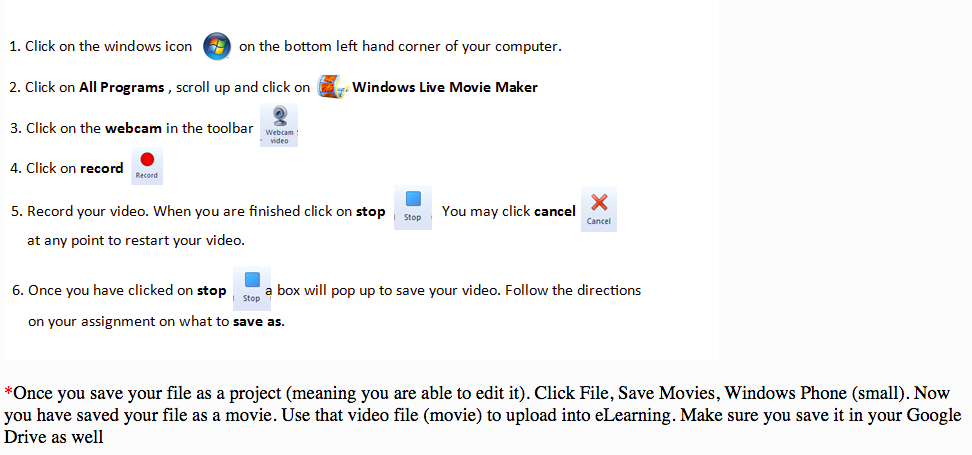
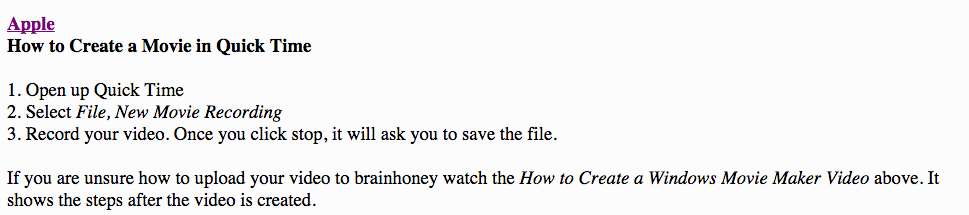
So you created a video for your class and you want to submit it for a grade? Here are the steps you need to follow:
https://api.agilixbuzz.com/Resz/~EdcxAAAAAAQJKy2w-NB1AA.KThRnXRlcP9RKhv-yySbCA/48500091,EE,5,0/Assets/Images/MovieMakerMovie.pnghttps://api.agilixbuzz.com/Resz/~EdcxAAAAAAQJKy2w-NB1AA.KThRnXRlcP9RKhv-yySbCA/48500091,EE,5,0/Assets/Images/QuickTimeMovie%20.png
Record on your Smartphone
QuickTime Player can record a movie from your camera, or record the screen of your iPhone, iPad, or iPod touch. It can also record audio from a microphone or record the screen of your Mac. 

Record a movie

Movie recording works with your built-in camera and many external cameras. If you're using OS X Yosemite or later, you can also record the screen of any iOS device (iPhone, iPad, iPod touch) with a Lightning port and iOS 8 or later. 
  1. Choose File > New Movie Recording.
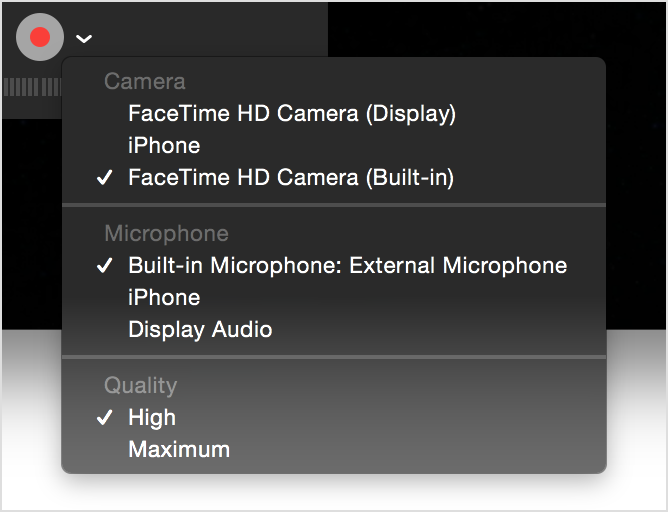
  2. To change the recording settings, click the arrow next to the Record button. Then choose your camera or iOS device, microphone, and recording quality.Movie recording window with settings menu
  3. To monitor audio while it's being recorded, use the volume slider. 
  4. Click the Record button   to start recording. Click it again to stop recording. 
Share

  1. After saving your movie, you can share it by Mail, Messages, AirDrop, YouTube, and other methods:
    • Open the file in QuickTime Player, then choose File > Share.
    • Or open file in QuickTime Player, then click Share   in the playback controls.
    • Or Control-click the file in the Finder, then choose Share from the shortcut menu.

After sharing, upload your film review as a blog post on your blog. This project is due Thursday (first deadline) or Monday, Oct. 16 (second deadline).

Please turn in your personal essay test today by the end of class. This counts as a "test" grade.

HOMEWORK: Work on Tasks 2 & 3 if needed. When you no longer need it, please return the Geeks to the library (or me). 

Wednesday, October 4, 2017

Hidden Figures: Day 3

Watch the film: Hidden Figures. As you view the film, take notes of what you notice happening in the film (both narratively--what happens in the story of the film--as well as how the film is put together, shot, and edited to make meaning.) You will use your notes to discuss the quality and effectiveness of the film when we complete it. This will be part of our critique of the film.

HOMEWORK: Complete Geeks for Tuesday's class. Be prepared to discuss the book  & take the quiz. Read "The Web Goes Social" about Social Media. Complete the questions/tasks on the handout for Tuesday's class.

Sunday, October 1, 2017

Hidden Figures: Day 2; A Short Film Dictionary; Film Critique Notes

Some brief film terms to watch for:
  • Auteur (French for "author") - literally the director, who is regarded as the "author" of a film because he/she has primary control and responsibility for the final product. The Auteur theory insists that a film be considered in terms of the entire canon of a director and that each Auteur earns that title by displaying a unique cinematic style.
  • Background Music- Music accompanying action on the screen, but coming from no discernible source within the film.
  • Composition - The placement of people or objects within the frame and the arrangements for actual movements within the frame or by the camera.
  • Continuity - The narrative growth of a film created through a combination of visuals and sound (resembling the "story" in print literature).
  • Crane Shot - A shot taken from a boom that can move both horizontally and vertically.
  • Depth of Field - The area within which objects are in focus; a large depth of field allows a great range of objects to be in focus simultaneously, while a shallow depth of field offers a very limited area in focus. Depth of field normally depends on how far "open" a lens is (a lens works much like an eye, with the pupil opening or contracting to control light). An "open" lens  creates a shallow depth of field while a contracted lens creates a large depth of field.
  • Dolly Shot - A moving shot taken from a dolly. A Dolly-In moves the camera toward the subject, while a Dolly-Out moves the camera away from the subject. A dolly shot creates a sense of movement through space by capturing changes in perspective.
  • Fade - A transitional device in which either an image gradually dims until the viewer sees only a black screen (Fade-Out) or an image slowly emerges from a black screen to a clear and bright picture (Fade-In). A fade provides a strong break in continuity, usually setting off sequences.
  • Flashback - A segment of film that breaks normal chronological order by shifting directly to time past. Flashback may be subjective (showing the thoughts and memory of a character) or objective (returning to earlier events to show their relationship to the present).
  • Flash Forward - A segment of film that breaks normal chronological order by shifting directly to a future time. Flash forward, like flashback, may be subjective (showing precognition or fears of what might happen) or objective (suggesting what will eventually happen and thus setting up relationships for an audience to perceive).
  • Frame - A single photographic image imprinted on a length of film; also the perimeter of an image as seen when projected on a screen (a filmmaker sees the frame as the boundaries of his camera's view-finder). 
  • Frequency - the repetition of a scene or action throughout the film. Some actions are repeated by the same or sometimes different characters to suggest meaning. 
  • High-Angle Shot - A shot taken from above a subject, creating a sense of "looking down" upon whatever is photographed.
  • Intercutting - The alternation between actions taking place at two distinct locations to make one composite scene. For example, cutting between two people involved in the same telephone conversation. The distinction between this and cross cutting is one of compression of time. The intercut can be used to speed up a scene and eliminate large pieces of time that would slow a story down.
  • Key Light - The primary source of illumination; High-Key - light brilliantly illuminates a set; Low-Key - light provides dim lighting, usually with heavy, dark shadows.
  • Match Cut - A cut intended to blend two shots together unobtrusively
  • Mise-En-Scene - The aura emanating from details of setting, scenery, and staging.
  • Narrative - How a story is told (what is included and excluded in the film).
  • Objective Camera - The attempt to suggest that the camera acts only as a passive recorder of what happens in front of it. The use of objective camera relies on de-emphasis of technique, involving minimal camera movement and editing
  • Pan - A shot in which a stationary camera turns horizontally, revealing new areas.
  • Reaction Shot - A shot showing one or more characters reacting to an action or statement. 
  • Reverse Angle Shot - A shot of an object or person taken in the direction opposite that of the preceding shot (for example, a shot of the gates of a prison from within followed by a reverse angle shot showing the gates from outside). 
  • Scene - A series of shots taken at one basic time and place. A scene is one of the basic structural units of film, with each scene contributing to the next largest unit of film, the sequence.
  • Script - (scenario, shooting script) - A written description of the action, dialogue, and camera placements for a film.
  • Sequence - A structural unit of a film using time, location, or some pattern to link together a number of scenes.
  • Story - The general subject matter and dramatic action or narrative meaning of a film (or story...)
  • Trucking Shot - Any moving shot with the camera on a mobile mounting, but chiefly a moving shot taken with a camera mounted on a truck.
  • Two Shot - A shot of two people, usually from the waist up.
  • Wide-Angle Lens - Any lens with a focal length shorter than normal, thus allowing a greater area to be photographed. A wide-angle lens alters perspective by making nearby objects seem relatively larger than those far away and by increasing the apparent distance between objects both laterally and in depth.

Watch the film: Hidden Figures. As you view the film, take notes of what you notice happening in the film (both narratively--what happens in the story of the film--as well as how the film is put together, shot, and edited to make meaning.) You will use your notes to discuss the quality and effectiveness of the film when we complete it. This will be part of our critique of the film.
Image result for hidden figures

Lab: Comment (on my blog post below!) on any part of chapter 4-6 and critique how a passage, idea, or section of one of the chapters made you think, connect, or empathize with the subject matter.

Work on YOUR blog: Specifically, write a post about your coming-out story about being a geek or a nerd; OR classify the different kinds of nerds and geeks that exist. Make sure you describe each type.

& Internet surfing exercise:
  • After writing the previous two blog posts, surf the internet. Can you find:
    • A helpful academic resource for writers?
    • A biased source for news? (bias can be any political or ideological prejudice)
    • A reliable source for news?
    • A good site for online games
    • A good site for reviews or critiques of pop culture: games, music, food, fashion, film, books, tv, or other mass media products, etc.
    • An online social media site
    • A popular meme (a humorous image, video, or text that is copied and shared through social media)
  • Share your findings on your blog. Provide a short (2-3 sentences, for example) review of each site you find as your 3rd blog post.
If you have nothing else to do, surf the internet or start reading that homework!

HOMEWORK: Please read chapters 7-9 of Geeks for Wednesday's class.

Game Review Article; Ready Player One

  Please write a review of the Atari 2600, NES or Sega game you played. Your article should include the following: 1. A researched historic...